
Know What Is Behind the Drywall
Interior walls in most Valley homes are wood or steel studs with half-inch drywall, usually at 16 inch spacing but sometimes 24. Exterior walls in a great many homes are concrete block with furring strips and drywall, so the stud finder beeps at thin strips of wood over a solid block wall. Newer homes may have wood-framed exterior walls with foam and stucco outside.
Before any holes are drilled, the wall type has to be identified. A stud finder, a small magnet to find drywall screws, and a test hole where the mount plate will cover it will tell the story. Guessing is how TVs end up on the floor.
Wood and Steel Studs
On a wood-framed wall, the mount plate is lagged into the studs with lag bolts or structural screws, and a plate that spans two studs is ideal for anything above a small bedroom TV. The bolts need to be centered in the stud, which is why we drill a small pilot hole and check with a probe rather than trusting the stud finder alone.
Steel studs are common in some newer homes and commercial spaces. Lag bolts do not hold in thin steel. Toggle bolts through the stud face or specialty steel-stud anchors are the right choice, and the plate should still span two studs.
For a TV that has to be centered between studs, a plywood backer board painted to match or a mount plate wide enough to reach both neighbors solves it without compromising the hold.
Block Walls
Many exterior walls in Peoria, Glendale and Sun City homes are concrete block behind the drywall, with the drywall held off the block by furring strips. The strips are usually too thin and too soft to carry a large TV. The right approach is to go through the drywall and anchor into the block with sleeve anchors or wedge anchors set into the solid part of the block, or with masonry screws into the web, depending on the mount and the TV weight.
This takes a hammer drill with a masonry bit, and the holes need to land in the solid portions of the block rather than the hollow cores. On a block wall done right, the mount is not going anywhere. Done wrong, with drywall anchors in the gap between the drywall and the block, it is one of the most common failures we are called to fix.
- Identify block behind the drywall before drilling
- Sleeve or wedge anchors into solid block, not the hollow cores
- Hammer drill and masonry bit, not a standard drill
- Never drywall anchors spanning the gap to the block
Outdoor TVs on Stucco
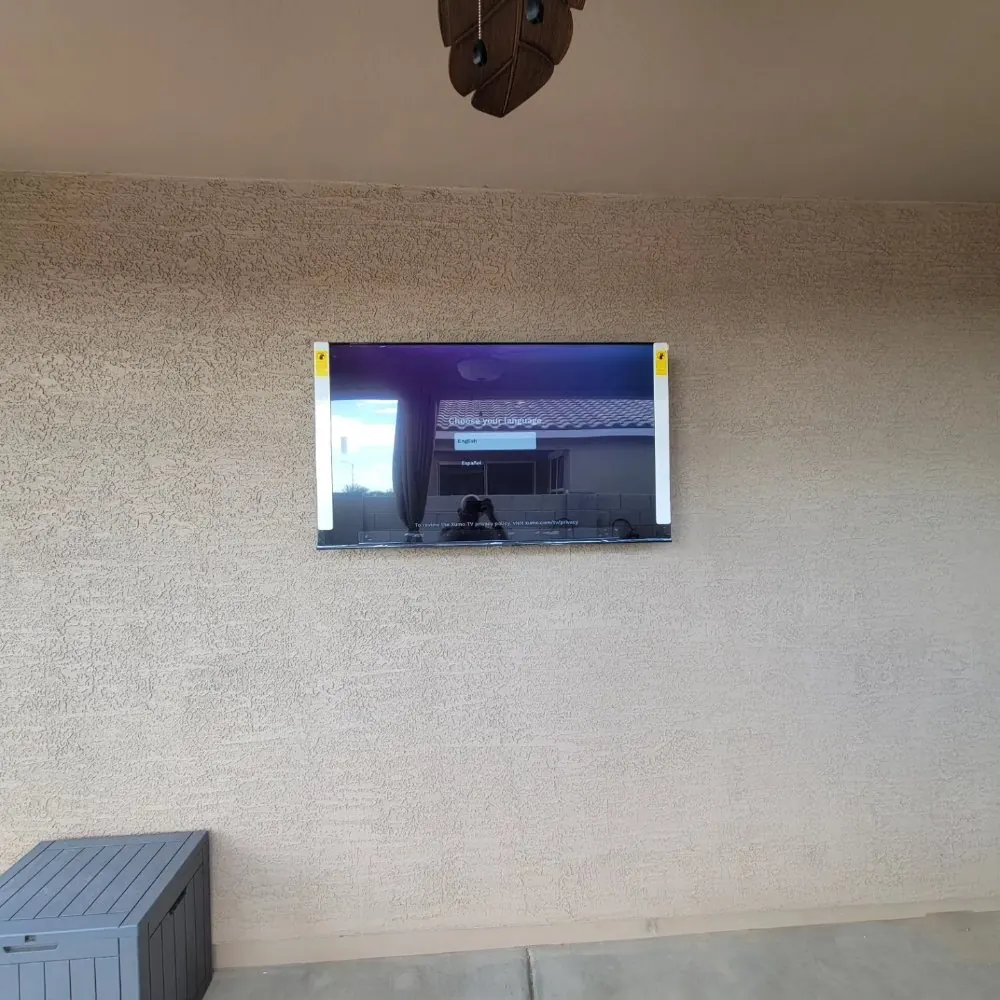
A patio TV on a stucco wall is a popular Valley project, and stucco is just the finish. What matters is what is behind it: block, or wood framing with sheathing and foam. On block, the mount goes through the stucco into the block with masonry anchors, with the holes sealed against monsoon rain. On a framed wall, the lag bolts have to reach the studs through the stucco and foam, which can be an inch or more of material before the wood starts, so bolt length matters.
The TV itself needs to be rated for outdoor use or be in a weatherproof enclosure. A standard indoor TV under a patio cover will fail from heat and humidity within a season or two. Shade and ventilation around the TV help, and a cover when it is not in use helps more.
Power and signal need an outdoor-rated outlet and a path for cables that does not leave them hanging in the weather.
Hiding the Cords
A clean install hides the power and HDMI cables. The simplest method on an interior wall is an in-wall cable kit, which puts a recessed outlet behind the TV and a matching one near the floor, with the power cord and HDMI run inside the wall between them. This keeps the install within code because the extension is a rated kit, not a loose power cord inside the wall. On a block wall there is often no cavity to run cables through, and a paintable surface raceway is the honest alternative.
Fireplace mounts are a special case. The wall above a fireplace is often block or has a chase with no clear path, and the heat from a gas fireplace can shorten a TV's life. A pull-down mount lets the TV sit high and come down to eye level, and we will check the wall and the heat before recommending it.
Choosing the Mount
A fixed mount sits flattest and is the simplest. A tilting mount helps when the TV is high, like over a fireplace. A full-motion arm lets the TV swing out and turn toward a kitchen or patio, but it puts far more leverage on the anchors, so the wall and fasteners matter even more. For any full-motion mount on a large TV, the plate must be in studs or block, never anchors in drywall.
Check the mount's weight rating and VESA pattern against the TV before buying. We can supply a mount or install the one you have, and we will say if the one you bought is not right for the wall.
What to Expect From the Visit
A standard interior mount with a cord-hiding kit takes about an hour to ninety minutes. A block wall or an outdoor stucco mount takes longer because of the drilling and sealing. Bring the TV, the mount and any soundbar or streaming devices you want connected, and we will level it, hide what can be hidden and test the connections before leaving.
- Wall type identified and fasteners matched to it
- Mount plate level and in solid material
- Cords concealed with a rated in-wall kit where possible
- TV tested, soundbar and devices connected
“We've had Nathan do several projects for us: installing a ceiling fan, changing out a vanity with a single sink to a dual, and changing a window into a sliding door and all of them were done very professionally with amazing attention to detail. I highly...”